Attorneys preparing a premises liability case often benefit from visual tools that help convey the environment, movement, and sequence of events that shape a plaintiff’s experience. That’s where MotionLit strategic visual storytelling becomes invaluable. Our animations bring rehearsal spaces, backstage layouts, and transitional areas to life, helping legal teams demonstrate how the surroundings contribute to the moments that matter in a claim. By presenting the scene, the fall dynamics, and the medical procedures in an animation presentation, attorneys gain a resource that supports expert opinions and enhances the way they frame their damages narrative.
When an incident occurs in a venue where performers rely on stable footing, clear spatial cues, and safe architectural transitions, MotionLit reconstruction and MOI animations offer an opportunity to illustrate the plaintiff’s interaction with the space. These visuals help unpack the complexity of backstage movement and staging conditions without oversimplifying the environment. For attorneys building settlement presentations or preparing evaluators to understand the context of the case, MotionLit provides a structured, engaging, and thoughtfully developed visual framework that supports the broader story of liability and injury.
In this example, the Animation Reconstruction guides viewers into a backstage corner of a well-known concert hall during rehearsal. A violinist prepares for her performance while seated near a shallow staircase positioned within a dimly lit area. As she adjusts her chair to continue practicing, one of the chair legs meets the edge of the step, shifting her balance and sending her forward into the stairwell. The resulting injuries include a traumatic brain injury; cervical involvement at C5-6 with herniations and C5-T1 bulges; lumbar findings from L3-S1; and trauma to the right clavicle, shoulder, and elbow.
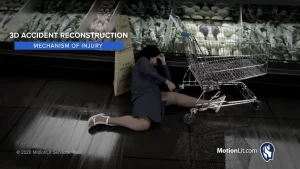
MOI animation continues the narrative by showing how the dynamics of the fall contribute to these injuries, illustrating the body’s movement as it transitions through the stairwell. A Surgical Animation completes the sequence by presenting the cervical fusion with cage implant and ADR procedure she undergoes as part of her recovery. Together, these animations form a beginning-to-end visual record that helps evaluators understand the performer’s path, from the rehearsal environment to the incident, to the medical intervention that follows.
Learn how MotionLit visual storytelling services deliver value-added, effective, and compelling support for your case presentations.
MotionLit.com | (855) 850-0650