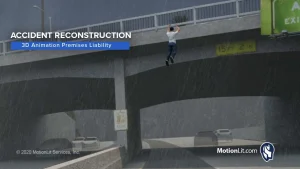
In personal injury litigation where liability is disputed, visual presentations are often necessary to address competing theories of causation and responsibility. In intersection collisions involving side-impact crashes, attorneys frequently rely on Accident Reconstruction Animations to support expert testimony related to speed, perception, visibility, and avoidance. At MotionLit, we produce reconstruction and mechanism-of-injury animations that translate crash data and medical findings into clear visual explanations, helping decision-makers understand how an incident occurred and why it was preventable.
This case arises from a severe intersection collision in which the plaintiff was traveling through the roadway in a pickup truck when the defendant, traveling at an unsafe speed, entered directly into her path. The resulting impact forces caused catastrophic injuries, including a traumatic brain injury that left the plaintiff in a coma, as well as multiple serious orthopedic injuries. With neither driver retaining memory of the collision, the defense advanced alternative theories of fault, including claims that the plaintiff was operating her vehicle without headlights to cast doubt on liability.
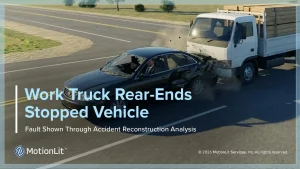
At MotionLit, we produced a comprehensive Accident Reconstruction Animation grounded in field scan data, speed and distance calculations, vehicle crush analysis, and expert findings gathered from the scene. Photomatched vehicle models and environmental mapping were used to recreate the intersection conditions and vehicle movements. The animation illustrates vehicle trajectories, travel times, and reaction windows, demonstrating how the defendant’s speed and failure to respond led to a devastating and avoidable collision. Additional animation views show clear lines of sight and establish how reduced velocity would have allowed sufficient time to avoid impact.
The reconstruction transitions into a focused mechanism-of-injury sequence addressing the plaintiff’s traumatic brain injury. Acceleration and rotational forces are visualized to explain how the collision dynamics produced the neurological trauma. Supplemental injury animations depict orthopedic damage, including lower-extremity injuries, with comparative sequences illustrating injury outcomes with and without seatbelt use. At MotionLit, we conclude the presentation with a concise medical summary animation, consolidating the full scope of injuries into a single visual format with clearly identified callouts.
Learn how at MotionLit, we help attorneys clarify disputed facts, establish liability, and present damages with precision through accident reconstruction, traumatic brain injury animation, and injury visualization.
Order visuals for your next trial presentation or speak with our visual experts today.
MotionLit.com | (855) 850-0650