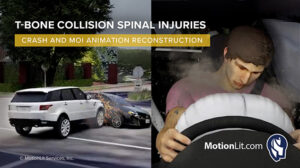
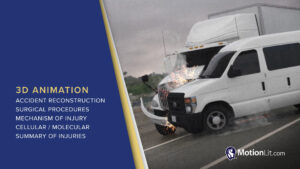
When determining liability in rear-end collisions, key questions often arise: could the crash have been avoided, and did the driver act negligently? Answering these questions requires more than opinion. It demands a data-driven accident reconstruction supported by clear, visual evidence.
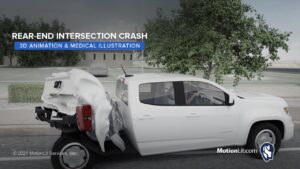
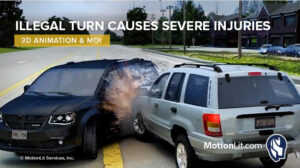
In this case, a work utility truck rear-ended a stopped Toyota sedan at a traffic-controlled intersection in Charleston County, South Carolina. The impact resulted in significant cervical, lumbar, and traumatic brain injuries to the plaintiff driver.
MotionLit’s accident reconstruction expert analyzed the available case data and translated those findings into a structured animation designed to establish liability through measurable evidence. Using Event Data Recorder (EDR) data, the animation illustrates vehicle speed, braking input, deceleration, and acceleration forces leading into the moment of impact. G-forces are visualized through vehicle motion and force transfer, reinforcing the severity of the collision and supporting biomechanical correlation.
A comparative avoidance analysis further evaluates whether the collision could have been prevented. By illustrating perception-reaction time, braking distance, and total stopping distance, the animation demonstrates that a reasonable driver response and proper following distance would have avoided the crash. This analysis directly supports findings of driver negligence.
The animation provides a clear, chronological breakdown of the sequence of events, including vehicle positioning, visibility, speed, and driver response. These elements are combined into a cohesive visual narrative that ties together liability and causation.
To support injury claims, the animation also demonstrates how collision forces translated to occupant movement. It illustrates cervical acceleration consistent with whiplash, as well as coup-contrecoup mechanics associated with traumatic brain injury. The visual correlation connects force transfer to cervical disc injury, lumbar trauma, and brain injury, reinforcing the relationship between crash dynamics and medical findings.
At MotionLit, our reconstruction experts transform complex collision data into compelling visual presentations that clarify liability and strengthen injury claims. Our animations help attorneys communicate facts with precision, support expert opinions, and improve outcomes in mediation and trial.
Work directly with our team to analyze your case and develop a reconstruction strategy backed by data, methodology, and expert insight.
MotionLit.com | (855) 850-0650